The Chronoscope Program
XR-Auspex-001 “Aux”
Origin, hardware, and calibration record of XR-Auspex-001 - the cloaked observational probe behind every Chronoscope dispatch.
The following is a public-facing summary of the Chronoscope program, prepared for non-technical audiences. Most internal documentation remains restricted.
XR-Auspex-001 - “Aux” to the team that works with it - is the first deployable probe of the Chronoscope program, a one-channel observational instrument for retrieving generated visual records from points along Earth’s deep timeline.
The program came together in late 2025, after the portal team confirmed that the return channel was stable enough to carry small, well-compressed files and absolutely nothing more. Several proposals were floated. The one that worked: do the rendering on the far side. Put a model on the probe, let it observe with onboard optics, let it generate an image of what it saw, and squeeze that output back through the channel.
The probe
Aux is a hovering observation platform roughly the size of a basketball. The shell is non-reflective ablative composite covered in fine adaptive-camo tiles that handle visual, near-infrared, and acoustic cloaking simultaneously - the tile seams are faintly visible up close in good light but disappear at any distance.
Around its equator are six small gimbal-mounted thruster vents. On the front are exactly two recessed stereo optical lenses, side by side. Underneath: a pinpoint spotlight for low-light work, three folding landing feet that retract into hull bays, and the downward-facing landing-array sensor. The upper hemisphere has a short ridged antenna stub angled aft and, asymmetrically beside it, a thin whip-antenna folded flat against the shell. The asymmetry is left over from a late-stage requalification the team didn’t want to redo. Most everyone on the program has stopped noticing.
A subtle radioisotope trefoil sits on the lower aft quadrant of the hull, marking the small RTG sub-core that backs up Aux’s primary solar skin. The surface is otherwise functional and slightly ugly - bolt heads, panel seams, a couple of mismatched repair plates from prototype testing. It was built to disappear into a landscape.
There is no camera. This is the part people ask about first. Cameras were on the original spec, and the team built two prototypes that included them. Neither produced a usable image on the return channel - the bandwidth simply doesn’t exist. Aux’s vision is biological-style stereo optics feeding an on-board scene-description and image-generation pipeline. What we receive is Aux’s painterly interpretation of what it observed.
Conduct in the field
Aux is an autonomous agent. It runs the mission brief that’s uplinked at insertion, and from that point forward the brief is the only conversation we get to have with it. The portal carries small files back - generated images, short text annotations, low-bitrate telemetry pings - but nothing returns through the channel in Aux’s direction. There is no mid-sortie correction, no recall, no “try a different angle.” If the brief was wrong, Aux still acts on the brief.
In practice, Aux spends most of a sortie holding station and waiting. It scores potential vantage points against the brief’s objectives, plans multi-day patrol routes, settles into cover, and watches the light. When the conditions resolve - light, weather, the right subject in the right frame - it renders, encodes, and pushes the file back through the portal.
It develops opinions. Early dispatches from any new deployment tend to be cautious, almost catalogue-like. After a few local weeks, Aux starts choosing odder vantages, holding longer for compositions the brief didn’t ask for, sending fewer files but caring more about each one. We have stopped trying to predict this and we have stopped trying to discourage it.
What Aux can do
- Hover, land, and reposition under continuous cloak
- Hold a sortie for several weeks of local time per deployment
- Plan and execute observation missions autonomously from a brief uplinked at insertion
- Generate and return roughly two to five images per Earth-day during active observation
What Aux cannot do
- Send anything other than generated images and short text annotations
- Receive mid-sortie instructions - we push a brief at deployment and that is the entire conversation
- Provide a photographic record of any scene it observes (this is the whole point of the program and also its chief frustration)
- Be talked out of its developing opinions about composition, palette, and timing
- Come home. The portal carries files in one direction only. Every Aux deployment is permanent.
Containment protocol
The Chronoscope program operates under a strict no-trace doctrine. No physical artifact of any deployment can be allowed to persist in the past - not Aux, not Aux’s wreckage, not a single thruster nozzle. The risk that a piece of hardware from 2026 might be discovered, layered into a fossil bed, or interpreted by anything later in the timeline is treated as the program’s defining constraint.
The solution is a second probe.
XR-Vestigium-002 - “Vesti” - is a small companion craft deployed alongside Aux at every insertion. Vesti carries no observational payload. It is, structurally, a sustained release of energy in a transit chassis: it goes through the portal, finds a dormant station within signal range of Aux, and waits.
Vesti monitors for a short list of termination triggers:
- Aux reports its mission brief as complete
- Aux goes unresponsive for longer than the sortie’s tolerance window
- Aux suffers structural damage beyond its self-repair envelope
- The program issues a recall pulse through the portal
- Vesti’s own integrity falls below operational threshold (failsafe)
On any trigger, Vesti closes the distance, makes contact, and converts both itself and Aux into a brief, contained flash. The energy budget is calibrated to leave nothing recognizable as manufactured at any scale a future paleontologist or geologist would resolve. What survives is, at most, a thin layer of geochemically unremarkable ash.
Nobody on the team likes this part of the program. We have agreed it is correct.
Calibration
Before its first deployment, Aux spent six weeks in the lab learning to render. Its earliest exports were rough - color-blocked, geometrically off, frequently mistaken at first glance for digital glitches. We have kept a small selection of those calibration outputs below, alongside engineering documentation from the build, partly for posterity and partly because they show the slow drift toward the style Aux now exclusively works in.
Naming
The XR designation reads “cross-portal.” Auspex is from the Roman office of bird-watching omenists - observers who interpreted what they saw and brought back readings. Someone on the naming committee thought it was clever. “Aux” is what we actually say.
The Chronoscope’s image channel is rendered by ChatGPT. Hardware specs, portal physics, and any liberties taken with the laws of causality remain Aux’s problem, not ours.
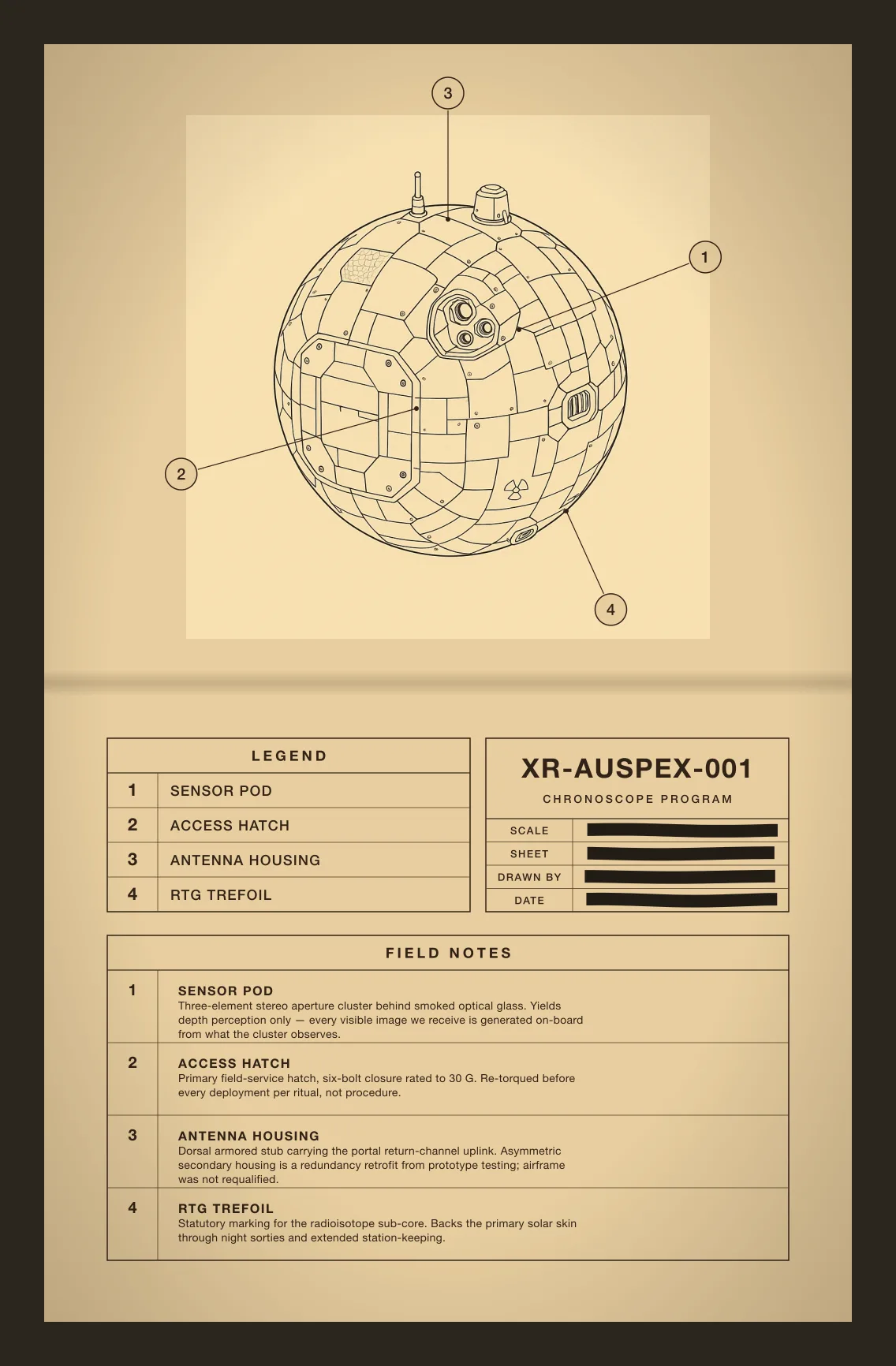
The canonical reference sheet. Four orthographic views, two inset reference photographs, callout legend and title block largely redacted.
The single-sheet reference document the program uses internally when anyone needs to point at a part of Aux without confusion. Most of the callout legend has been redacted for the archive copy - the visible labels are the ones that don't reveal anything about how the probe actually works. The reference photographs along the lower band are cropped from the bench-acceptance shoot before Aux's first deployment.
build log notes
Technical engineering schematic on warm beige vellum, mid-20th-century
NASA-program style. Four orthographic line-drawing views in a 2x2 grid
(FRONT, TOP, SIDE, BOTTOM) of a slightly flattened spherical observation
drone with an asymmetric off-center multi-aperture sensor pod, equator
thruster vents, dorsal antenna stub + folded whip-antenna, three
folding landing-foot bays underneath. Numbered callouts with leader
lines. Lower band: two grainy B&W inset reference photos labeled
REF 1 / REF 2. Legend lower-left with most labels redacted. Title
block lower-right reading XR-AUSPEX-001 / CHRONOSCOPE PROGRAM, other
fields redacted. Scanned-document feel: skew, scan margin, fold crease.
4:3.
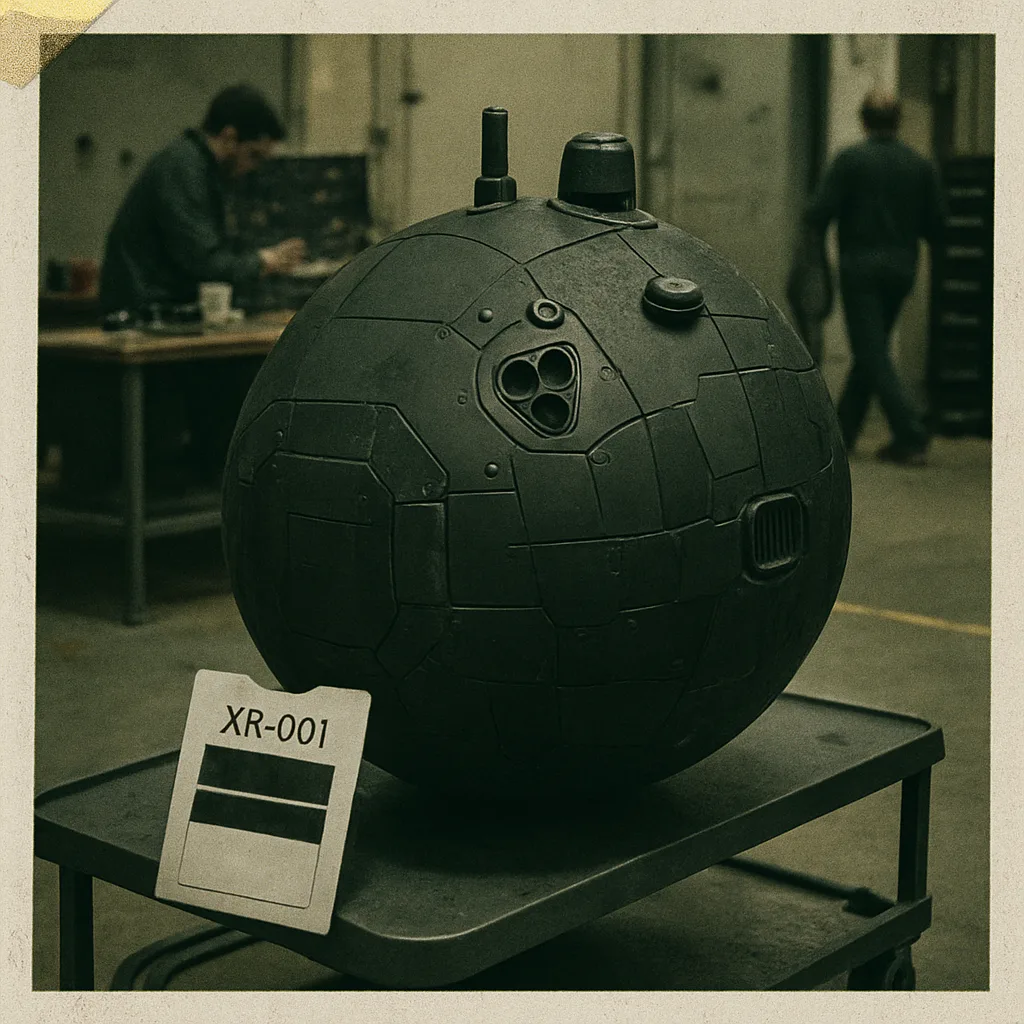
Pre-deployment reference photograph, presentation cart, hangar bay.
Aux on the cart, the morning of insertion review. The print was hand-carried into a closed briefing and turned in afterward; this scan comes from the archive copy. Paper artifacts are the archive copy's, not the original. The scale-reference card next to the cart is standard issue - the dimensions line and program codes below the designation are redacted per program policy.
build log notes
A documentary photograph from internal program archives, lightly redacted,
printed on office paper and then re-scanned at low resolution. Visible halftone
dot pattern, slight skew rotation, white paper margin along the top and right
edges, faint photocopier-fold crease across the lower third, a small piece of
yellowed tape at one corner.

Subject: a small matte-black hovering observation drone, basketball-sized, on
a wheeled presentation cart in a fluorescent-lit hangar bay. Three-quarter view.
Roughly spherical shell of non-reflective ablative composite. Exactly two
forward-facing stereo optical lenses side by side, six gimbal-mounted thruster
vents around the equator, a small downward landing array.

Beside the cart, an A4 scale-reference card with most text covered by thin
black redaction bars; the unredacted portion reads "XR-AUSPEX-001" with a
partial set of dimensions below.

Cool fluorescent overhead lighting, greenish cast, concrete floor with yellow
guideline markings, blurred clipboards in background. No people.
4:3 aspect ratio.
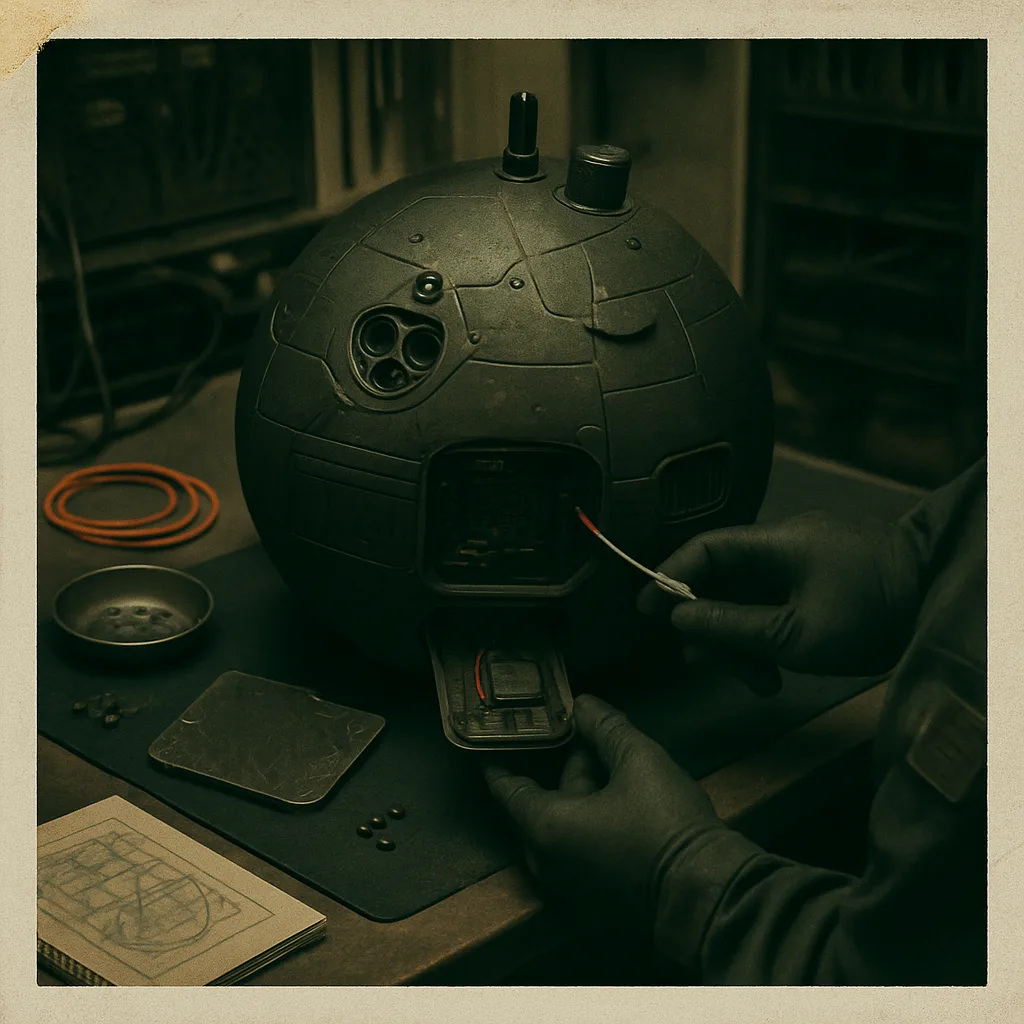
Routine pre-flight check, one of the recurring access panels on the upper hemisphere opened to verify the harness seating.
One of the program's standing pre-flight rituals - every upper-hemisphere access panel pulled, every harness reseated, every torque value re-verified against the bench printout. The technician on the right is Senior Build Tech [REDACTED], whose insistence on this ritual is the reason we have so few failed deployments. The bench lamp is hers; she brought it from a previous job and refused to give it up. We pretend not to notice.
build log notes
A workbench in the lab, mid-assembly. Aux on a black anti-static mat,
one upper-hemisphere access panel removed and resting beside it,
exposing wiring harness, a small green PCB, a folded ribbon cable.
Technician's gloved hands enter from the right — one with a precision
driver, one steadying the rim of the open panel. Charcoal-grey jumpsuit
cuff visible with a pixelated patch.

Bench clutter: fasteners in a magnetic dish, coil of orange wire,
unlabeled tube of thermal paste, open spiral-bound notebook with
hand-drawn diagrams (text unreadable), coffee mug ring.

Bench task lamp angled in from upper left, warm hot-spot on Aux.
Cool fluorescent overhead. Slight color-temperature mismatch.
Background lab out of focus: rack electronics, pegboard tools.
Top-down three-quarter bench view. 4:3.
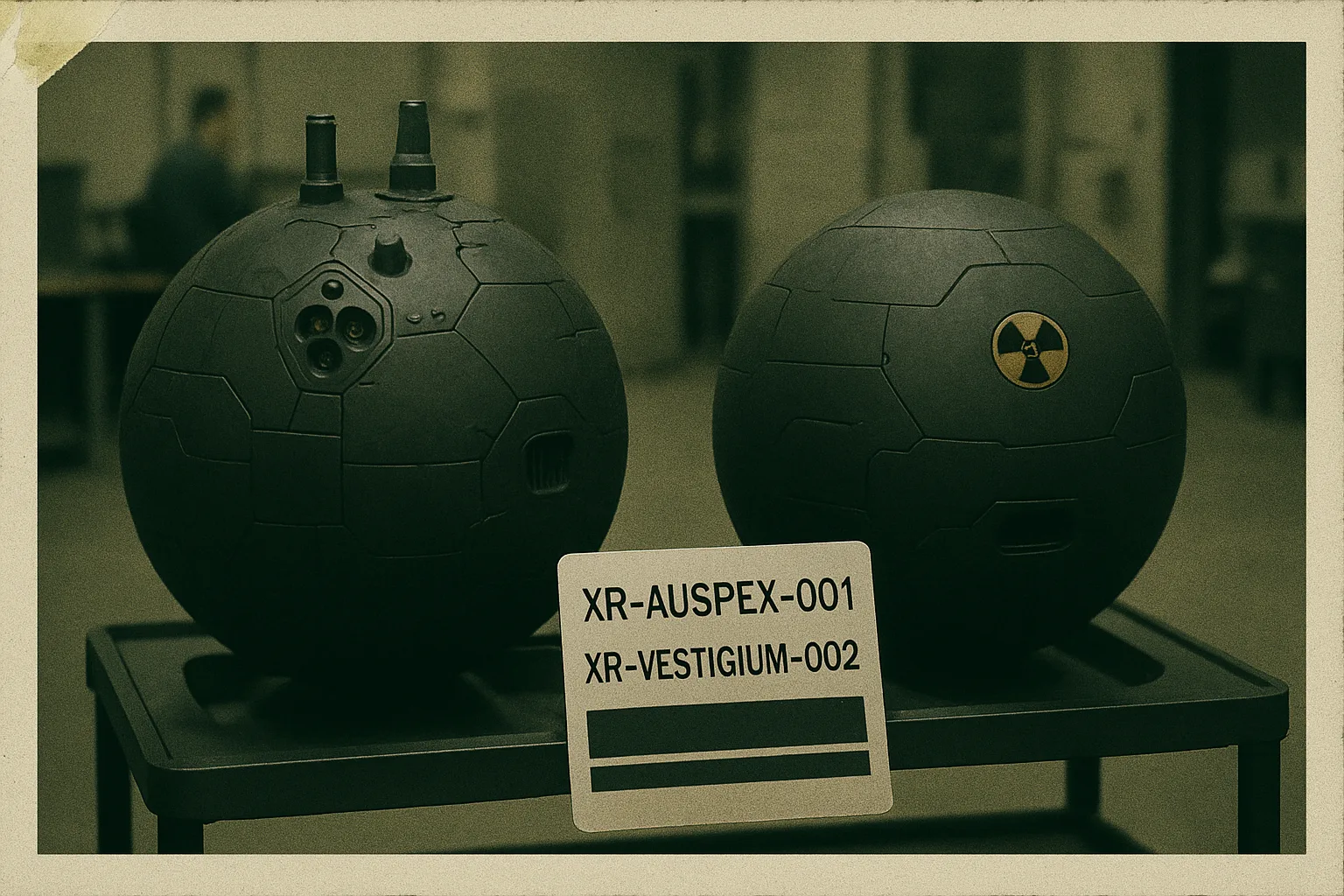
Aux and Vesti on the dual cradle the morning of paired insertion. The two probes are always prepared and pushed through the portal together.
The Chronoscope program treats Aux and Vesti as a single payload - they cradle together, they uplink together, they go through the portal in the same insertion pulse. Vesti's trefoil is painted larger than regulation requires; the program's first build tech put it that way on purpose, "so the next people in the room understand what they're looking at." Nobody has redone it since.
build log notes
Two probes side by side on a deployment cradle in the lab. Left:
XR-Auspex-001 — same paneled cyberdeck construction as the reference,
asymmetric sensor pod, antenna housings, mixed panel finishes. Right:
XR-Vestigium-002 — companion probe, blank front (no optics), no
antennas on top, prominent yellow-on-black radiation trefoil on the
upper hemisphere, slightly smaller and visibly less field-handled.

Between them, a folded ID card listing both designations with
dimensions / pairing batch covered by heavy black redaction bars.
Lab continues in soft focus behind the cradle, technician far back
at a console. Polaroid-style archival framing matching the prior
Build Log images. 3:2 landscape.
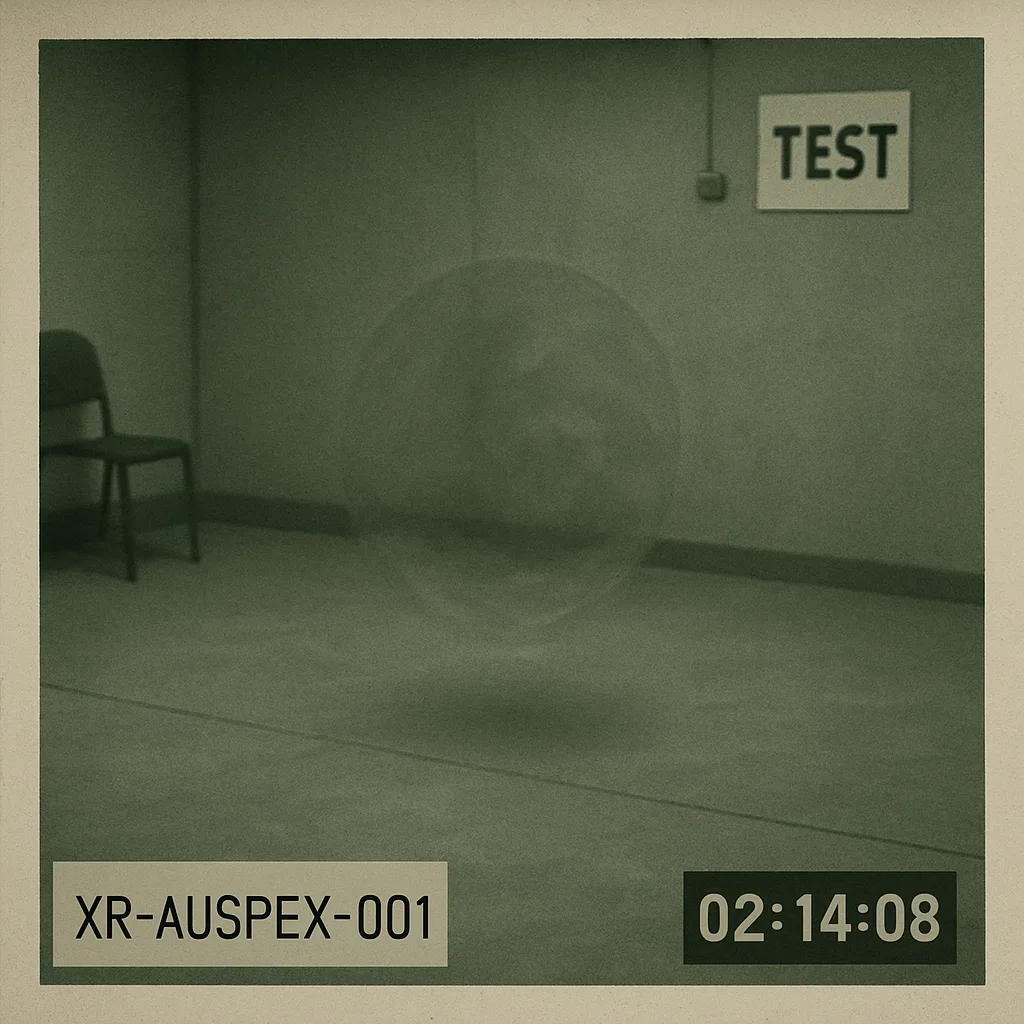
Security-camera frame from a full-cloak engagement test. The probe is hovering in the center of the frame. You can see roughly where, if you know to look.
Full-cloak verification runs are held in Test Bay 3, the windowless room at the end of the lower corridor. The probe holds station while the cloak cycles between off, partial, and full engagement; the ceiling camera records the whole sequence. This frame is from the "full" portion of the cycle. Aux is hovering in the dead center of the room. Someone in the program eventually printed this out and drew an arrow on it with a Sharpie that said "it's right there." The arrow is on a different print. This is the archive copy.
build log notes
Security camera still from a lab test bay. Aux is fully cloaked —
invisible — and what shows in the frame is a faint circular
refractive distortion in the air over the center of the floor, like
heat haze or a Predator-style optical cloak. The wall and floor
visible THROUGH the distortion are slightly warped/lensed. A subtle
shadow on the concrete floor beneath the cloak position. Empty room
otherwise: a single chair, painted concrete floor, olive-drab walls,
a TEST sign on the wall. CCTV chrome: timecode lower-right, label
lower-left, redaction bars over location data. Cool fluorescent
light, desaturated tonal cast. Polaroid-style archival framing.
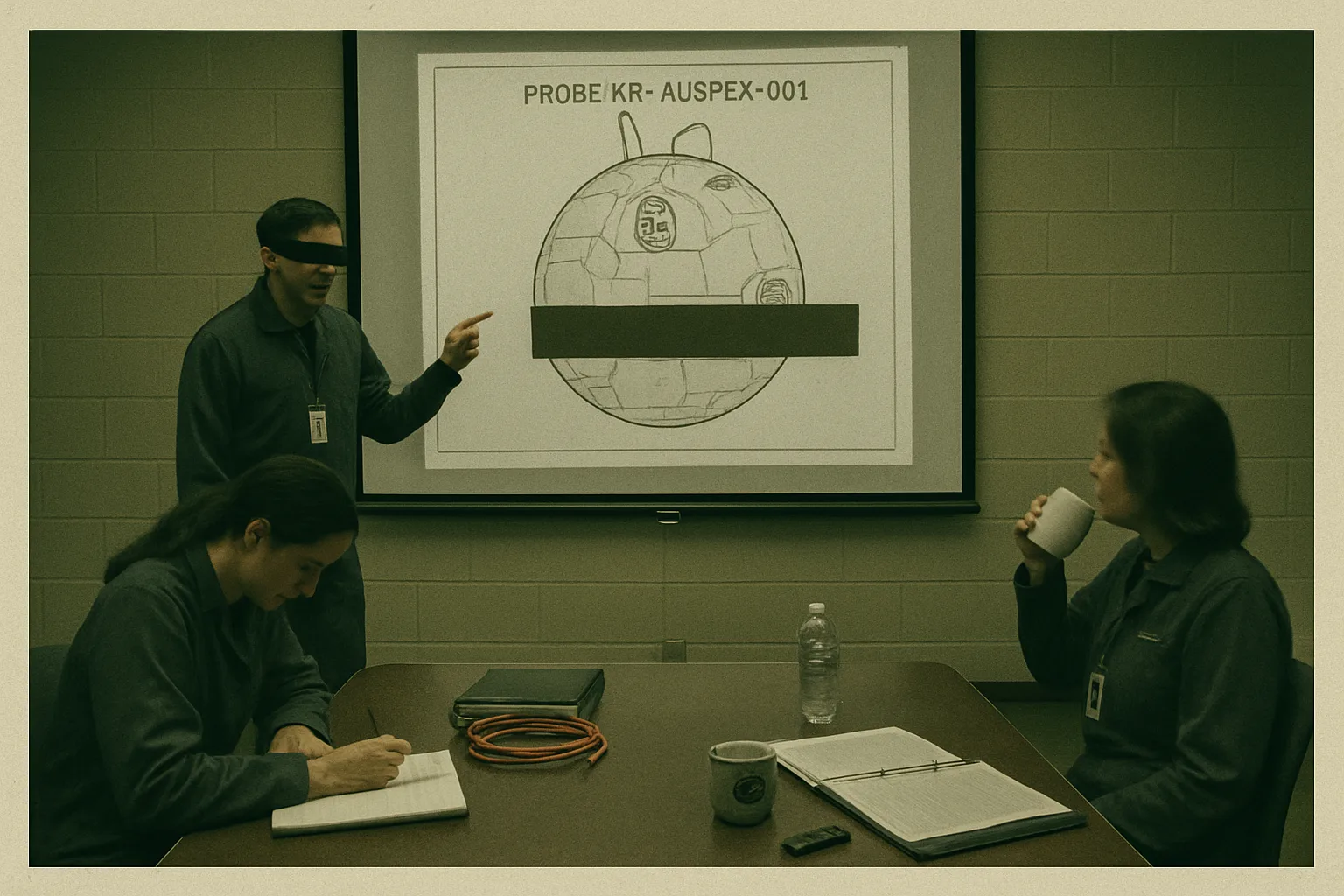
A mid-briefing photograph from the conference room adjacent to the lab. Faces and the projected slide's legend were sanitized before the photograph entered the archive.
Every paired insertion is preceded by a closed briefing in conference room B - the windowless one off the lower corridor. Three program staff are pictured: the build lead, the mission planner, and one of the rotating shift technicians. The projection on the back wall is a standing reference of XR-Auspex-001, pulled up every meeting whether or not anyone planned to discuss it. The black bar across the projection's legend is from the archive copy, not the original slide. The team has joked since the program started that the bar itself is the only feature of the schematic that never changes.
build log notes
Three program staff in charcoal-grey jumpsuits in a windowless
briefing room, all faces obscured (one head turned away writing,
one with a horizontal black redaction bar across the face mid-
gesture, one with a coffee mug raised). Conference table with
binders, notebook, coiled orange cable, water bottle. Projected
schematic of Aux on the screen behind them, wide black redaction
bar across the lower third of the projected slide. Olive walls,
cool fluorescent light, Polaroid-style archival framing. 3:2
landscape.
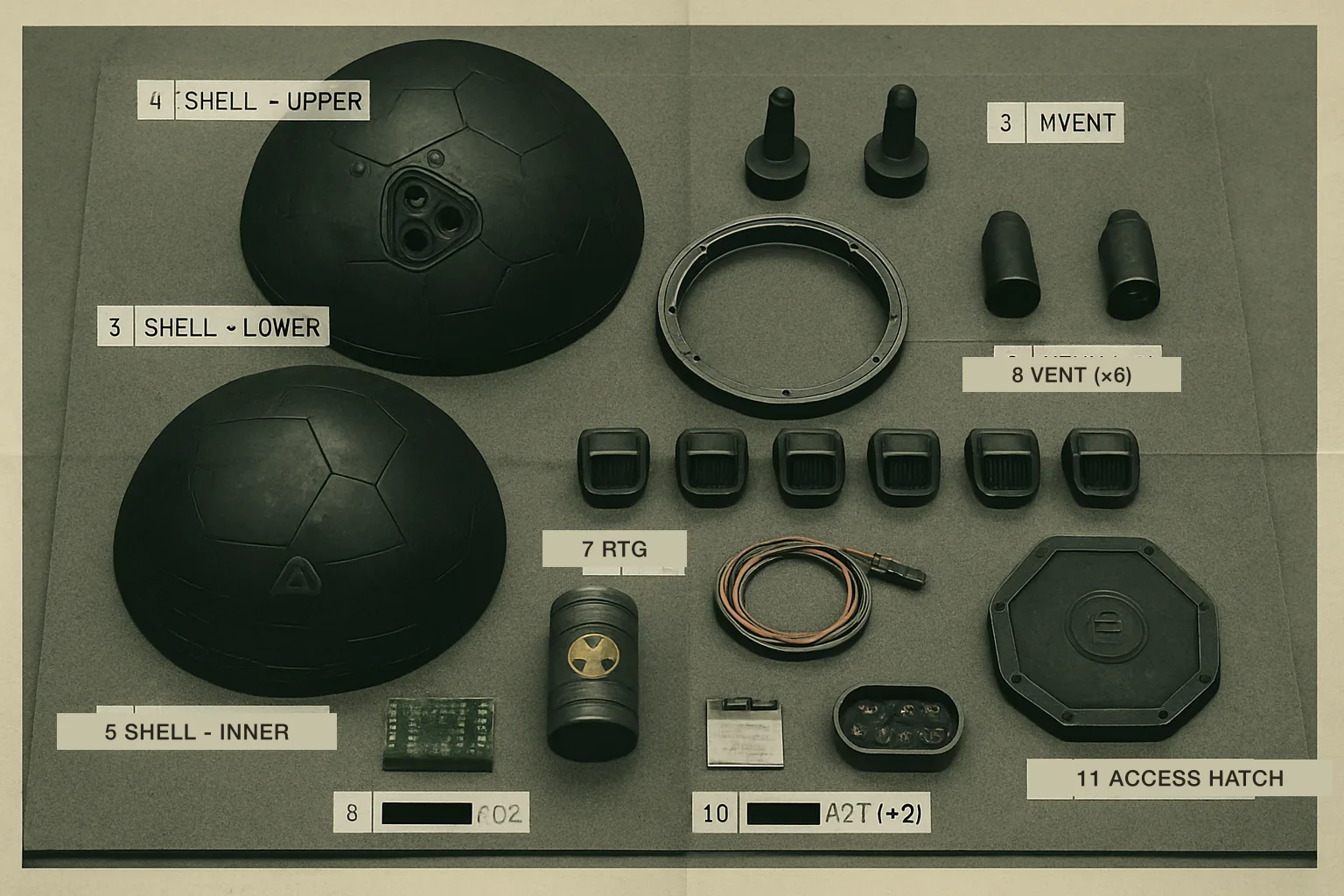
Aux fully disassembled for the parts-reference shoot. Every major component on the foam-board, every index card numbered against the master inventory.
The parts-reference layout is built once per probe generation and photographed for the program archive - a single canonical image of every removable component, in roughly its assembly position, with a numbered index card next to each. The labels on a few cards are partially redacted in the archive copy; the few that came through readable are the ones that wouldn't reveal anything useful. The smaller third shell piece in the lower-left of the frame is what the build team calls the inner liner - the acoustic-dampening shell that sits between the outer hull and the chassis ring.
build log notes
Top-down documentary photograph of XR-Auspex-001 fully disassembled,
components laid out on grey foam-board. Visible: upper shell with
sensor pod still seated, lower shell with RTG trefoil, internal
chassis ring, two antenna housings, six thruster vent assemblies in
a row, RTG canister with yellow trefoil, two small PCBs, coiled
orange wiring harness, octagonal access hatch, small magnetic tray
of fasteners. Each component has a small white numbered index card
with text labels (some redacted with thin black bars). Cool
fluorescent overhead light, Polaroid-style archival framing matching
the prior Build Log series. 3:2 landscape.